

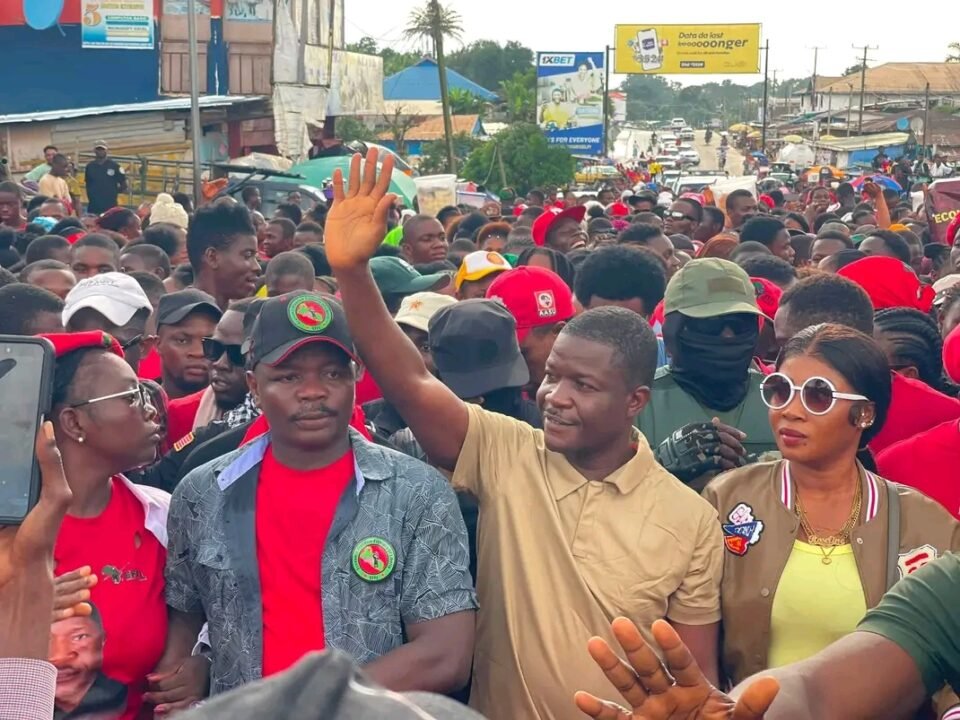
By Gegee Brima
MONROVIA, LIBERIA — Economic Freedom Fighters of Liberia (EFFL) Commander-in-Chief Emmanuel D. Gonquoi has called on the Liberian Government to reconsider its proposed US$5.7 billion arrangement involving Bea Mountain, warning that the agreement, in its present form, could expose the country to serious financial and sovereignty concerns.
Gonquoi said his initial position was supportive of the government’s efforts to secure funding for major infrastructure development, particularly electricity and road construction. However, he explained that further examination of the proposed arrangement had raised questions about its financial structure, long-term implications and the benefits expected to accrue to Liberia.
In a statement captioned “The Difficult Truth,” the EFFL leader argued that although the development objectives behind the proposal are attractive, the financing mechanism requires closer scrutiny. He expressed concern that Bea Mountain could emerge as the major beneficiary of an arrangement intended to advance national development.
He further urged the government to assess the proposal against Liberia’s broader economic and national-security interests, particularly as the country pursues a Millennium Challenge Corporation (MCC) Compact that includes support for the energy sector.
According to Gonquoi, Liberia must carefully examine the international and geopolitical consequences of its financing decisions rather than commit to an arrangement without sufficient consideration of its long-term impact.
As an alternative, he advocated exploring direct project financing from international development partners outside the International Monetary Fund framework. Under his proposal, funds would be made available to the Liberian Government through the Central Bank of Liberia, while tax proceeds generated by Bea Mountain could serve as a potential repayment mechanism.
Gonquoi also expressed readiness to assist in mobilizing approximately US$3 billion within four months, subject to the necessary institutional backing and cooperation.
He identified China as another potential source of financing, suggesting that the government could negotiate a project-based loan arrangement and establish an escrow account into which relevant tax revenues from Bea Mountain would be deposited to facilitate repayment.
The proposed US$3 billion development package would target four major national priorities:
- Energy Development: Construction of a 700-megawatt power generation project combining hydroelectric and heavy fuel oil sources.
- Healthcare Expansion: Construction of a new John F. Kennedy Medical Center and three additional regional hospitals.
- Education Investment: Development of 40 standard senior high schools, including residential facilities for teachers.
- National Road Connectivity: Construction of roads linking all 15 counties to improve transportation and economic integration.
He maintained that the proposed projects should undergo comprehensive feasibility assessments to establish their actual costs, technical requirements and implementation timelines.
Gonquoi argued that the four development priorities could potentially be financed for less than US$3 billion. However, his statement did not include detailed cost breakdowns, feasibility findings or confirmation of any financial institution prepared to provide the proposed funding.
He stressed that the government should not proceed with the Bea Mountain arrangement in its existing form without addressing the concerns surrounding its structure. Instead, he called for a more transparent financing framework that would protect Liberia’s economic interests while ensuring that major national projects deliver measurable benefits to citizens.
Gonquoi ended his statement with a message of determination, writing, “Our feet shall take us there,” before signing off with his political slogan, “The Coming Revolution.”
